
A long time ago, as a new bra pattern designer, I faced decisions about bra sizing. It was, and still is, easy to be confused. I call ready-to-wear sizing the ABC method of measuring, and it can be confusing. Some companies want the full bust measurement and the high bust measurement, and then have you subtract the two to find your cup size. Still others want the rib cage measurement plus a “magic number” they pull out of the sky (could be 3, 4, or 5) to determine your band size. My first decision was about the band size—should I use the actual rib cage measurement, or should I add a magic number? Then, decisions about the cup size. Should I use a DD size or not? What about DDD, which does not exist in many parts of the world? Sewists in other countries are baffled by the way we measure for bra patterns and are shocked when the bra pattern size isn’t the same as their ready-to-wear ABC bra size. It was a real dilemma for me.
So… I developed my own method of bra sizing, called the Bottom Cup Depth, or BCD method. I used the method to create my patterns because it was a method that worked. I did worry that no one would understand this whole new method of measuring, even though the method is clearly easier to understand and to use than the ABC system. The BCD method of measuring is better, and here’s why.
The BCD method measures the distance from the apex of the breast down to the wire line directly below it. That measurement in inches will determine your cup size and the frame (cradle) that it sits in. The rib cage measurement is taken directly under your bra. That actual rib cage measurement (no magic number involved) is used for the band length. The combination of BCD and Rib Cage is your pattern size. For example, the BCD might be 4.0 and the rib cage 32. In my BCD system, you would be a 4.0/32.
The BCD size increases by 1/4″ (6 mm) per size, so if you happen to make a bra cup that is too small, you simply go up to the next BCD size. So if you made a 4.0 BCD, and it was too small, you can make the 4.25 size. Isn’t that crazy easy? No more figuring out “sister sizing,” or moving up one band size and down one cup size, or relying on inconsistent ready-to-wear sizing. It is so logical; it is astonishing why this hasn’t always been the way bra patterns are designed.
If you already have a bra pattern that fits, you can determine the BCD from that pattern. That will make it easy to find the BCD, assuming the seam across the bra runs across the bust point. Simply measure from the seam line (not the cutting line) at the apex, straight down to the seam line below it. For most patterns, it is the deepest area of the lower cup.

You should take the BCD measurement using a bra that fits. In a perfect world, the bottom cup depth on your bra should measure the same as the bottom cup depth on your naked breast, but it often doesn’t—because of the breast density and degree of flaccidity. The nipple will drift downward as the breast loses its self-supporting ability, which means that even if your bra size does not change over the years, your BCD may still decrease as you age. Nothing stops gravity. So it is imperative to wear a bra that fits (not a foam-lined bra, or a sports bra either). The bra, correctly sized, will actually appear to place the nipple in the ideal location, even if the nipple drifts downward during the day!.
Here is a chart that shows what BCD sizes correspond with “most” ready-to-wear sizes in North America. You can also use the chart to find your ABC size and determine which BCD size you should use when you want to sew your own bra.
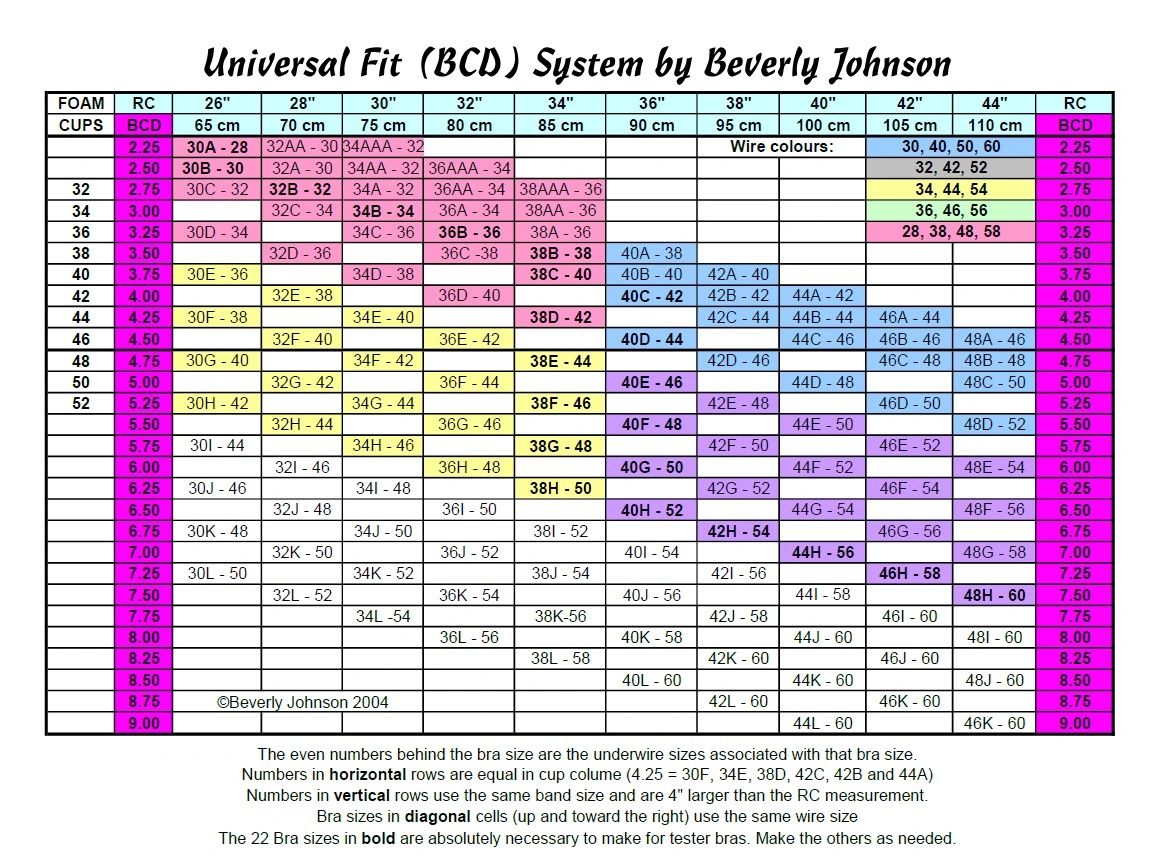
All patterns I have created for the Pin-up Girls line, as well as any new ones in the Beverly Johnson line use and are named as their BCD size. Now you know why it is better than the ABC system!