
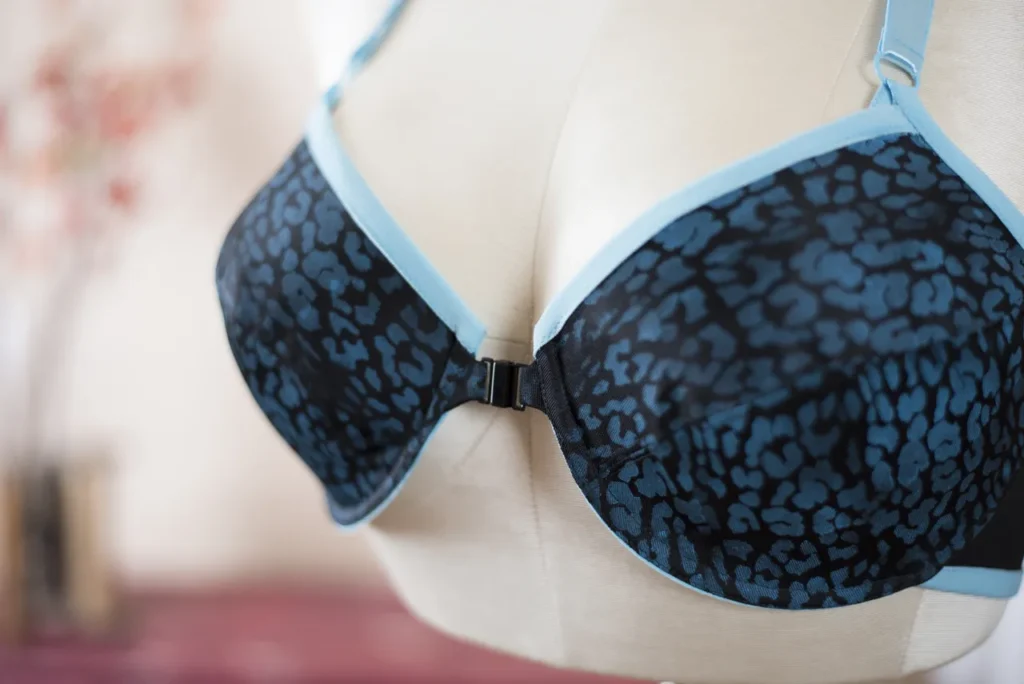
You can use FOB / FOE as an alternative on any edge that currently uses 1/4″ to 1/2″ (6-12 mm) wide elastic. But there is a bit of preparation to do to the pattern first. If your pattern was designed for regular elastic trim, you need to remove the elastic turn-under allowance from that edge in order to use FOE. That’s because FOE sews at the level of the finished edge; it never turns under. There is no second layer of fabric bulk along that edge. If there were a fabric strap you would also remove the seam allowance on that edge as well.
FOB / FOE is available in several widths, from the tiniest 3/16″ (2.5 mm) up to a substantial 3/4″ (18 mm) width. I find that for most bra fabrics, the FOE that finishes to 3/8″ (9 mm) works consistently well. A width smaller than that tends to be difficult to sew on for most, while the wider ones do not curve nicely around curves. So I tend to use the 3/8″ (9 mm) for all of my projects.
Most FOB / FOE are also reversible, showing off a shiny side or a matte side depending on the way you use it. The matte side has a very suede-like appearance and is perfect for non-shiny or more tailored-looking fabrics. If you haven’t tried the matte side of FOE, maybe you should!
I always press FOB / FOE in half prior to sewing it on the edge. This makes the application process so much easier.
There are many ways to apply the FOB / FOE ; here are the two most common.
This is likely the most common method of sewing on FOE. Leave the FOE open (no pressing). Pin and sew the FOE to the wrong side of the edge using a small zig-zag (width 2, length 2). Wrap the binding to the front of the garment, and stitch again with the same stitch. You can use a zig-zag or a three-step zig-zag as shown at the bottom right.
Advantage: you can see what you are sewing at all times.
Disadvantage: two times the sewing (is that a bad thing?) Also, the stitches from both passes are visible on the wrong side of the garment.
If you want to sew a fold-over using only one pass of the sewing machine, why not try adhesives? You can use either a glue stick…or Wonder Tape to hold the FOE to the edge of the fabric.
In both cases, apply the adhesive to the fabric, not the FOE. The adhesive is best applied to the wrong side of the fabric, too—it is much easier to sew knowing the back side is held firmly in place. Don’t worry about stiffness with either product; they both dissolve completely in the first wash.
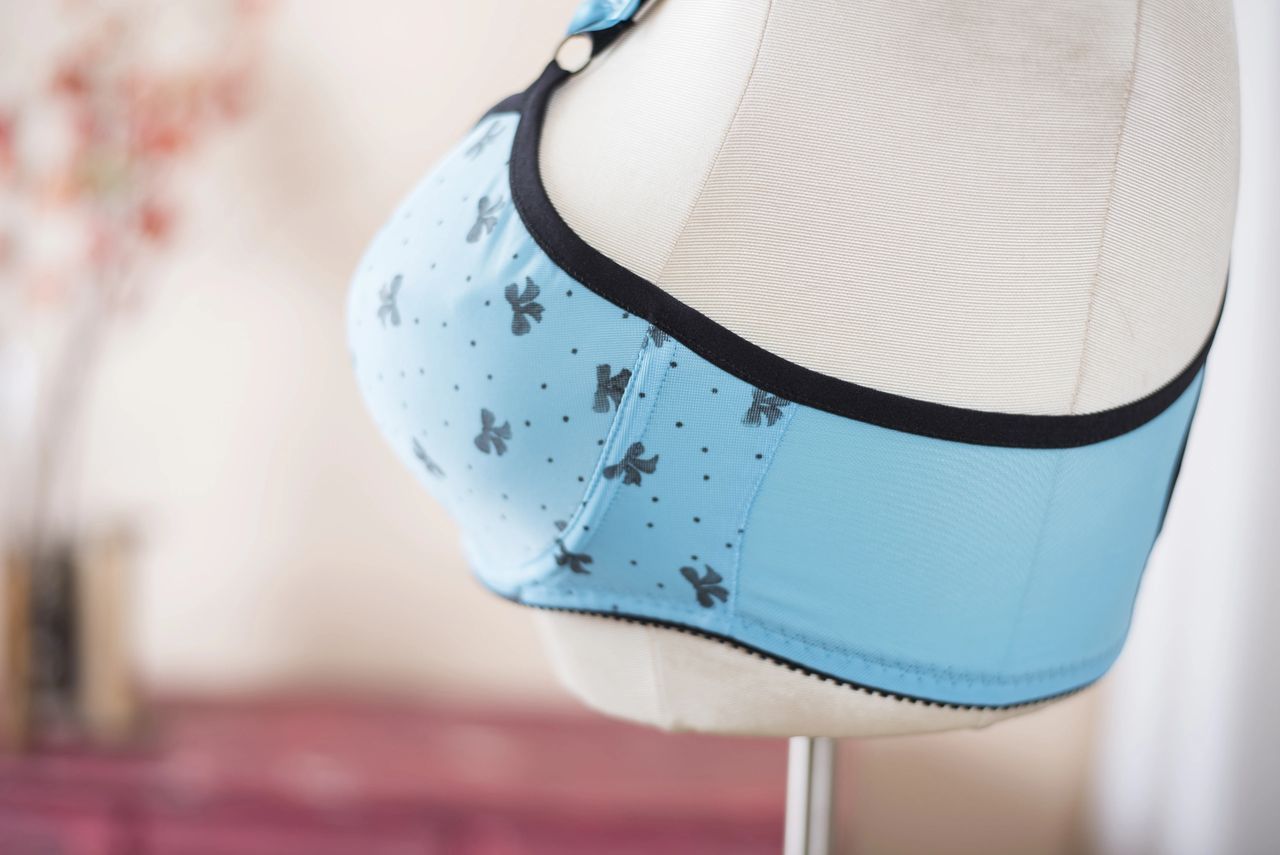
You should always try to plan the FOE so it ends at the edge of your fabric. But it may not always be possible. For example, on an armhole or a scoop neck pullover sports bra, or even the waistline or legs of panties?
In this case, you need to sew the FOE together before you sew it on. There are two ways to join fold-over elastic and both are good. In both cases, measure the length of the edge, then subtract 1″ (25 mm) from that and cut the FOE to that length. The seam allowance is included.
The first join is the straight join, and it sews just like it sounds. Sew the two ends of the FOE as a straight seam, then sew it to the edge, pinning as you go to make sure it stays put around the curves. You can trim the edges of the seam for less bulk.
You can also do a mitered join, or a bias join, as it is often called. The two ends are crossed at a ninety-degree angle, then sewn from point to point where the top fabric crosses the bottom. If you sew exactly from one intersection to the other, the join will be perfect. Trim any excess from the seam and carry on.
Pinning helps, especially on those curves. Even with glue and/or Wonder Tape, you will find pins useful.
In preparation for sewing, set your machine up for a zig-zag stitch with a length and width of 2 mm. If you prefer a three-step zig-zag, you may want a width of 3.5 mm to 4 mm and a length of 1 mm to 1.5 mm. All machines vary slightly, and always test a scrap of fold-over and fabric to make sure the elastic lies smoothly after stitching and the edge of the fabric does not wave or cup inward.
Align the left edge of the fold-over with the inner edge of the “hole” in the presser foot so the stitching rides along the edge of the fold-over.
Consider joining my Facebook group. Our bra-making enthusiasts would love to share your successes and help with any fitting challenges you may encounter.